| Sun Exposure Soil Type Soil pH Soil Moisture Care Level Flower Colour Blooming Time Foliage Color Plant Uses & Characteristics Flower Head Size Height Spread Growth Rate |
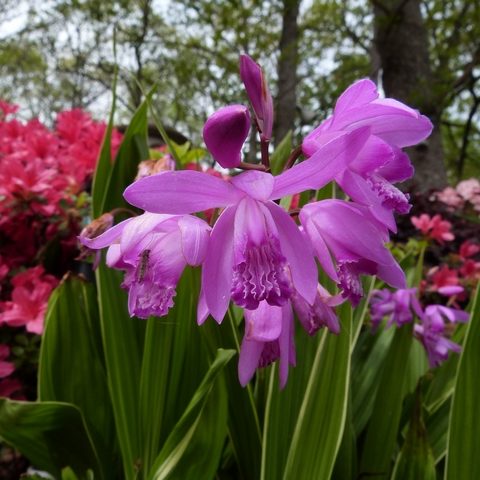
Partial Shade Normal , Sandy or Clay Neutral, Alkaline or Acid Average or Moist Moderate Deep Pink Late Spring to Summer Deep Green Containers, Cut Flower Medium 20-30 cm / 8-12 inches 20-30 cm/ 8-12 inches Slow |
The idea of growing an orchid out in your garden bed would astound and amaze most gardeners. But since the Chinese ground orchid (Bletilla striata) thrives in U.S. Department of Agriculture plant hardiness zones 5 through 9, it is possible for many gardeners to do just that. Chinese ground orchids prefer well-draining and organic soil, partial shade and regular waterings of at least once a week during the growing season. Chinese ground orchids grow from corm-like pseudobulbs, which are actually modified portions of the plants’ stems. Large clumps of three to six slender, pointed leaves spread 1/2 to 1 1/2 feet wide and 1 to 1 1/2 feet tall. The leaves are pleated with some ridges running throughout their length; they’re thinly textured and reach about a foot long. One variety (b.s. albostriata) has leaves striped with green and white. Flowering Habits Dozens of small, orchid-like flowers appear above the leaf clumps in pinkish-purple, light pink, white or bluish-lavender. The flowers themselves are about 1 1/2 to 2 inches long and grow in clusters of three to five flowers on stems rising about 18 inches. Blooms last about six weeks. Fall Growth Even after the flowers fade, the leaves on a Chinese ground orchid will continue to remain attractive. In early fall, as the weather cools, they begin to turn yellow. Reduce watering at this point and stop altogether when the leaves die. Make a note of exactly where your plant is in case you want to divide it in early spring before new growth starts. Dividing is easy, but the plants actually bloom best when the roots are somewhat crowded. Dormant Stage The psudobulbs of a Chinese ground orchid do best when you plant them in their dormant stage in late fall to early spring for blooms in mid- to late spring. Plant the corms 1 inch below the surface if you live in a mild climate, and up to 4 inches below the surface in colder climates. Mulch keeps the Chinese ground orchid healthy wherever it grows. B. striata is one of the few terrestrial orchids suitable for general cultivation in Texas and the Gulf South. In recent years several variations on the original plant have become available and interest has increased in collecting and growing them. It thrives in the shaded or partially sunny garden with a moist, humus-rich soil. The spikes of purplish-pink flowers emerge early in some springs and can be damaged by late spring freezes unless mulched well. Leaves are usually about 1 inch wide. When established, almost every 12-15″ shoot will rise up from the pseudo-bulb containing up to fourteen individual, orchid-like flowers. Foliage is 12-18″ in length and pleated. Established clumps can have dozens of flower spikes, each individual flowers resembling a miniature Cattleya orchid. Propagation is by dividing large clumps in late summer to early fall. Originally from China and Japan, Chinese Ground Orchids were first cultivated in England around 1994. At first only the standard B. striata was available. It is considered to be one of the most hardy, usually thriving from Zone 6 through 9. B. albostriata, which has narrow, pleated, white edged leaves, is also considered substantially hardy. The Japanese striped variety ‘Gotemba Stripes’ has many narrow streaks of gold over the leaves. ‘Kuchibeni’, another Japanese cultivar, has two-toned flowers in purple and white, and ‘Murasaki Kichibi’ displays a pale bluish-lavender with a darker lip. There are also varieties that can be thought of as almost white from a short distance. These varieties are also relatively hardy. |
| Information on this page is from Missouri Botanical Gardens, Dave’s Garden, All things Plants or Texas Superstar |